
|
February
2002
|
Many
companies and organisations, and perhaps yourselves, now have websites, but
are these sites really accomplishing what is expected or required of them? Are
they costing more in maintenance fees than they seem to be worth? Whatever the
issue with your website, by combining database technology with your web technology,
you may at last get the power you really need.
Database technology has been with us, pretty much, since the dawn of the computer.
The speed and complexity of data retrieval has certainly improved but the principles
are, basically, the same; you enter information and store it, you search for
information and retrieve it.
Data is simply information. There is no real limit to the kinds of information
that can be stored. Text, images, video, sound; basically, anything that can
be converted to a digital form can be stored in a database. Some common kinds
of database include mail merge, library catalogues, bank or building society
accounts and retail stock control. These are only a few of the potential uses
for databases, and although they may seem very different, they use the same
principles.
So, what are the principles behind databases, and how can they work with a website?
Database Principles Explained
A working database is made up of two basic parts. Tables and queries.
Tables
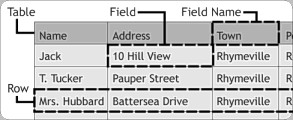
A table contains data entries with identical structures. It’s made up of rows
and fields. Each row represents an individual data entry. Each field represents
a section within that entry.
For example, a simple address book database may have fields for Name, Address,
Town, Postcode and Country. The information in each field for one address book
entry makes a row. Each new person added to the database would make a new row,
and although the information in each row is different, the structure of each
row is the same. In other words, every row has a Name, Address, Town etc.
Adding data to a database is very simple; depending on your software it can
vary from typing directly into a table, as in the diagram, or via a form that
inserts the new rows automatically. Retrieving data from a database is more
complex. To do this we use queries.
Queries
In everyday language a query is a question. That is basically what it means
for databases too, except that databases don’t understand plain English. Instead,
databases are asked for information via their own form of code. This code can
manipulate the data in many ways before it is displayed. For instance it can
sort data in to alphabetical order or date order, or it can ask only to display
people living in a particular town, and many more ways.
Although most office databases have these functions built in to work at the
touch of a button, programmers can write their own queries to accomplish special
tasks. This is one of the things that makes it possible to include databases
within websites.
Database Powered Websites
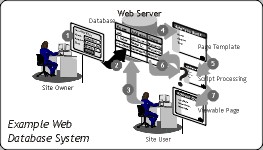
Database powered sites are made up of two main parts; the database itself, and
what is called the “Front End”. The front end defines what the site will look
like in terms of layout, colour and general appearance; basically a kind of
template. The database contains the content or information that will be displayed
within that template.
Although the general layout of the templates can be written in HTML (Hyper Text
Mark-up Language), the front end must also contain the database queries; the
code that asks the database tables for the required information. These queries
can be written in several different scripting languages, common ones are ASP
(Active Server Page) and PHP (Hypertext Pre-processor). These languages can
make the server manipulate information from a database and insert it into a
web page, before delivering that page to you.
Database Website Advantages
One of the greatest advantages of a database driven website is that the database
is stored on the server. This means that, with the right front end, your database
can be maintained and updated from virtually anywhere. It means that more than
one person could help maintain the database. It also means that you can update
the information in your website through a form in your browser. You would be
able to take care of your own site maintenance without knowledge of web design
or computer programming. Updated information would be available to site visitors
instantly. Database information is also searchable, allowing your site visitors
to find the information they want, quickly.
Scaleable To Needs
At Presbury and Company, we have produced database driven sites for a variety
of needs. Perhaps the largest database site we have produced was for www.worldwidehealth.com.
This site contains a health business database. The front end allows users to
search for health practitioners and businesses local to them. New database entries
can be added via an internet browser. The whole search facility can be expanded
and added to from anywhere with internet access. Updating is password protected
so only authorised people can make changes to the database.
A smaller project had different needs. www.angliaroofing.com wanted an online
portfolio of their roofing work that they would be able to maintain themselves,
through their browser. Their database system allows them to add new categories
of work and new jobs to any category. They can include pictures of their work,
along with text descriptions, and all information is displayed in an attractive
template.
Presbury Can Do It
Whatever your existing website set-up, if you want to know more about what a
web database could do for your site, feel free to call us and discuss your needs.
Our team is knowledgeable, experienced, and will work with you, to produce the
system you really need. From online stock catalogues and hotel bookings, to
portfolios and search engines, web databases could be a long lasting solution
for your effective web presence.
J. Stamp & Sons Funeral Directors, an established family business in Market Harborough, required a way of keeping people informed, that would promote their quality image. It was also requried to give additional credibility, reinforce their company name, and allow people to retain important documents and certificates. In response to the final job the company said:
“All partners are thoroughly pleased with the professional approach and attention to detail from the Presbury team. A very high quality document which will be very well used.”

That’s because Presbury takes all the hard work off your shoulders. Letting us do what we know best leaves you to do what you know best.
What do we do best?
• Graphic Design
• Print
• Web Design
• Multimedia
• Exhibition Display
• Packaging
• Marketing
• Advertising
• Corporate Identity
• Internet Access
• Email
• Web Hosting
• Domain Names
• E-commerce
• Web Databases and more...
For
more information on any of the topics above call 01509 600367
© 2001 Presbury & Company.